
Happy WNBA finals! While the world rightfully watches the Atlanta Dream and the Golden State Valkyries battle it out for WNBA supremacy, it is hard not to think about our Toronto Tempo and what it will take them to get to this stage one day.
After a rollercoaster season that started with promise and ended with injuries and disappointment, the Tempo have a golden opportunity to take steps in the right direction this offseason.
Here are five questions that they need to address:
- Who can end our frontcourt woes?
As the season unfolded, it became abundantly clear that the Tempo have a glaring need for an improved front court.
On the defensive side, they ranked second last in points in the paint allowed per game, giving up 42.8 points per game. Only the Los Angeles Sparks did worse with an average of 42.9 points allowed. The Tempo also were tied for last in the league in defensive rebounding. On the offensive side, discussed further in question 2, the Tempo also struggled to score in the paint all season long.
Unfortunately, finding frontcourt help this offseason is easier said than done.
The upcoming rookie draft is loaded with guards and small forwards. Trades are possible but trickier to pull off. At the moment, finding better frontcourt players through free agency would be the most straightforward route to improvement.
Going into the offseason, the Toronto Tempo will have a sizeable $4.2 million in cap space that they can use to sign players.
Two bigs that the Tempo should target includes:
1) Awak Kuier from Dallas Wings. At just 25 years old, Awak Kuier is a big who can protect the rim, rebound, defend at a high level, shoot the 3-ball, and is efficient offensively (in the 2026 season, she shot 39 percent from 3 and 50% overall). As a bonus I can see her working in tandem with Nyara Sabally and/or Aneesah Morrow. On the other hand, Kuier might still struggle to face the strongest bigs in the league (such as Angel Reese, Aaliyah Boston, or Olivia Nelson Ododa).
2) NaLyssa Smith. Smith is a pure inside force on both ends of the court. On the offensive end, Smith is a master in the low post area. She can play bully ball and grab offensive rebounds for putbacks and second chance opportunities. Before she was unfortunately injured with a season-ending injury, Smith was the league’s leader in field goal percentage. On the defensive end, she can go toe-to-toe with the strongest bigs in the league and hold her own. Her strength and size also makes her a strong rebounder and rim protector. However, the chances of Las Vegas giving up on a key starter who helped them to win a championship one year ago is far-fetched. The Tempo can try to throw money at her, but she might not be interested in moving on from a great situation.
There is no easy solution, but this will be the most important question the Tempo needs to answer.
- Can we come up with a more successful offensive game plan?
While the Tempo had a fairly strong start to the season offensively, the latter half of the season was a bit hard to watch.
For instance, during the first half of the season, the Tempo ranked eighth with 20.3 assists per game. In the second half of the season, they ranked last in assists per game at 18.8.
In the first half, the Tempo ranked third in pace (a metric that measures the number of possessions a team uses per 40 minutes and is an estimate of how fast a team plays). In the second half, they ranked eleventh.
The Tempo’s 3-point percentage also dropped from third at 36.6% in the first half of the season to twelfth in the league at 32%. Meanwhile, they continued to rank fourth in the league in average 3-pointers attempted per game.
You can see it in the games too. By the end of the season, the Tempo relied on more isolation-heavy possessions or the ball would get stuck with a player who then has only a few seconds to turn water into wine. This typically led to an ill-advised 3-pointer.
While we can pile on and list all the things that went wrong during the latter part of the season, more importantly, we do need to highlight that the Tempo struggled scoring inside the paint all season long.
However, the great Dan Falkenheim’s advanced stats show that it wasn’t for a lack of trying. The Tempo TRIED to score inside the paint (his graphic shows that the Tempo’s attempts at scoring near the rim was actually slightly higher than league average). Unfortunately, the Tempo just weren’t very good at it (his graphic also shows that the Tempo were less efficient than other teams when it came to scoring near the rim).
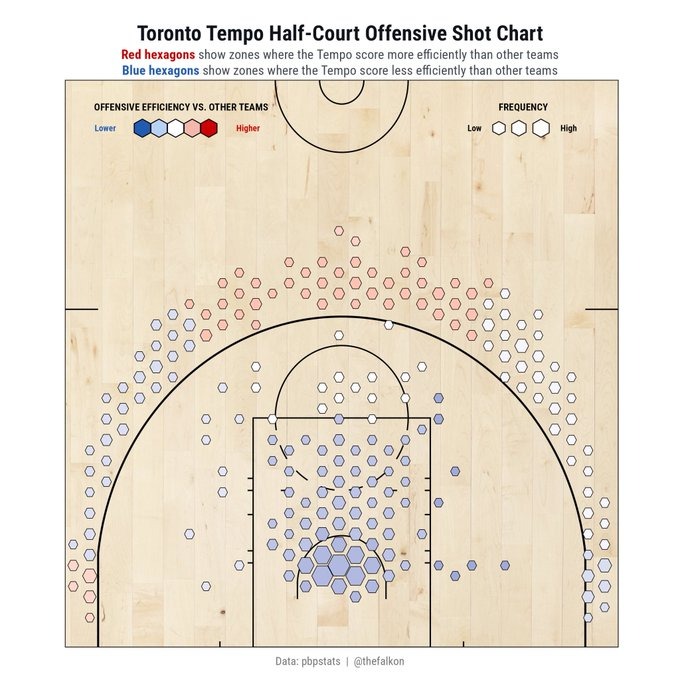
Source: Dan Falkenheim
Thinking about next season, Coach Sandy Brondello and her team will have to decide if the Tempo’s style of play before the injuries hit, including a drive-and-kick style with better ball movement, transition points, and free throw opportunities, can still work or if we need to rethink our offensive gameplan.
- Should the Tempo revisit their mix of veterans vs young players?
Going into their inaugural season, the Toronto Tempo ranked fifth in the league when it came to the average age of players (28). In comparison, Portland Fire ranked 11th in average age of their players at 25.5 years.
Looking back, it was clear that the Tempo assembled a more veteran squad with the goal of being competitive right away. Unfortunately, injuries derailed our season, but this outcome also raises an interesting question for the team in the offseason.
Older players are more prone to injuries. Moreover, throughout the season, we saw that the Tempo struggled against more youthful energetic and physical teams.
Going into this offseason, the Tempo have an opportunity to rebalance the age of their team with this offseason. Veterans Temi Fagbenle, Isabelle Harrison, and Kia Nurse will be free agents. Meanwhile players such as Maria Conde, Zaay Green, and Ornella Bankole hit early restricted free agents and Nyara Sabally is a restricted free agent.
Perhaps, the front office have noticed the imbalance already which led them to pivot and trade for Aneesah Morrow (who is only 23). It will be interesting to see whether the Tempo try to get some more youth into their organization to pair with Kiki Rice, Aneesah Morrow, and the high first round pick from the upcoming rookie draft.
- Can we develop a defensive identity?
The Toronto Tempo’s need for a defensive identity was one of our key observations going into the second half of the season. Unfortunately, since then, the defense has only gotten worse.
The Tempo ended the season as the worst defensive team in the WNBA. Injuries help to explain this issue. A need for a bigger and better frontcourt also helps to explain this issue.
As we have seen in this year’s playoffs, the two best defensive teams made it to the finals with similar styles of being very physical, energetic, aggressive, and disruptive on the defensive end. How the Valkyries and Dream play might be the way of the future and the Tempo need to step up in this area.
Looking towards next season, how the Tempo perform defensively will be an indicator of whether they can be a playoff team or not.
- Who is a starter and who isn’t?
The Toronto Tempo currently share the best odds to select the top pick in the upcoming 2027 rookie draft. This is very exciting and the player they pick can potentially be franchise-changing.
As mentioned earlier, this draft is also unfortunately guard and wing-heavy and any top player drafted won’t be the savior for the Tempo’s frontcourt issue.
What it could also unintentionally do is create a logjam in next season’s starting lineup. The Tempo already have our million dollar backcourt in Brittney Sykes and Chef Marina Mabrey.
The Tempo also struck gold with rookie guard, Kiki Rice, who made the WNBA all-rookie team after averaging an impressive 13.4 points, 3.7 rebounds, and 3.5 assists, as well as being off the charts in advanced metrics (thanks to Tempo Stats Nerd for banging that drum all season long).
The Tempo will now have the ability to draft another guard in Juju Watkins or Hannah Hidalgo, or Madison Booker who typically plays the small forward position.
Ultimately, one of these four key players will have to come off the bench next season. Who that ends up being will not be an easy decision for the Tempo and how the starting lineup ultimately shakes out could give hints to how this team builds moving forward.